Horse, across Europe
A landscape map for export
Sources
Geography, dictionaries and the references behind the map.
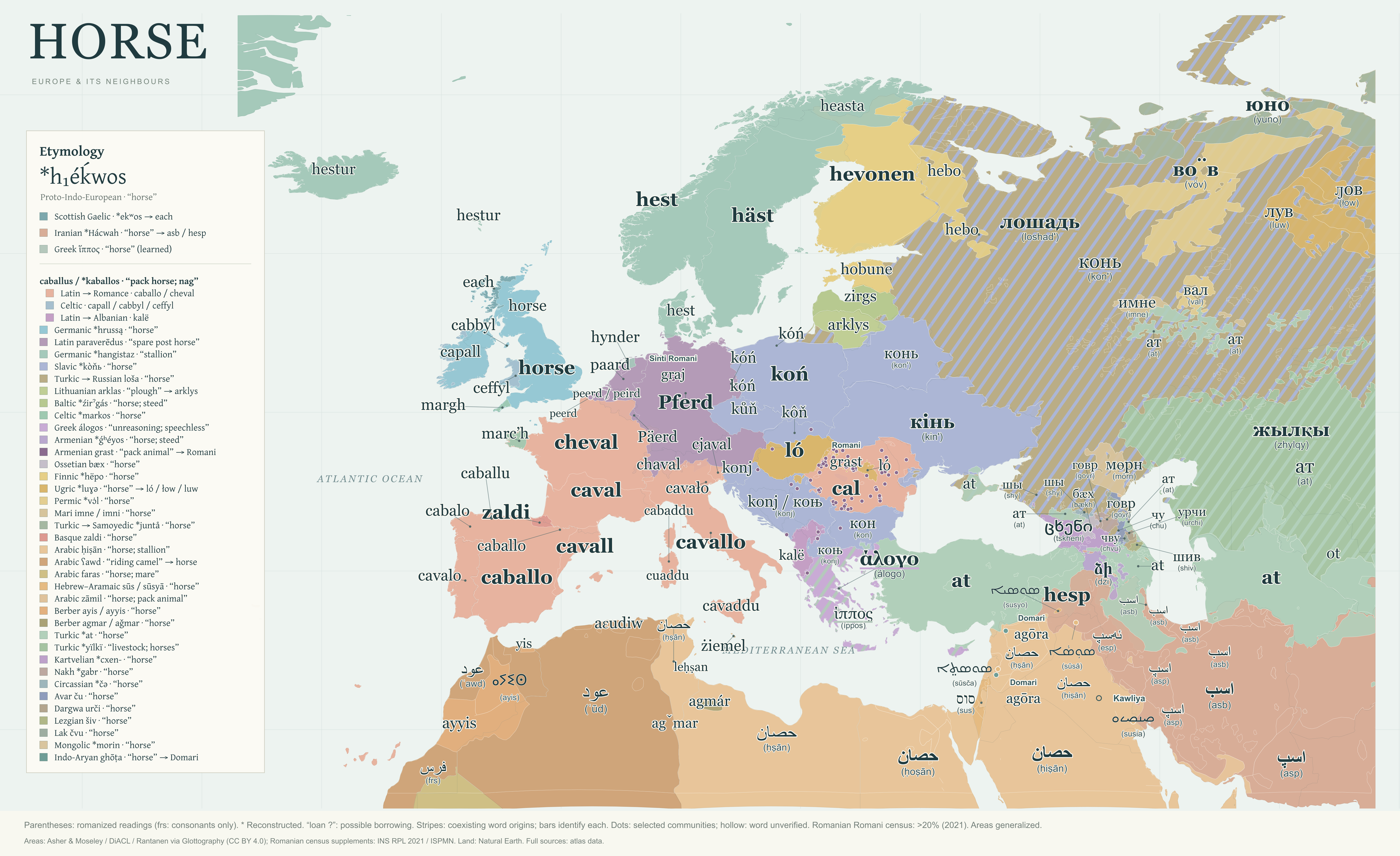
The PIE horse noun *h₁éḱwos has separate Scottish Gaelic, Iranian and Greek route colours. Greek learned ίππος (Ancient ἵππος, híppos) is displayed alongside everyday άλογο. These are selected surviving lineages, not an exhaustive list: Latin equus is another.
The caballus / *kaballos family has a shared heading and three separate route colours: Romance, Celtic and Albanian. Romance words continue Latin caballus; Albanian kalë is a Latin loan. The related Celtic terms retain their individual histories and disputed early borrowing directions in the entry notes.
Published overlapping footprints remain above a complete Natural Earth reference fill. Inside Romania, the old Hungarian atlas area is replaced by INS RPL 2021 data mapped by ISPMN: administrative units above 50% Hungarian mother tongue among known responses. This separates the Székely enclave from smaller western pockets, and does not claim speakers below that threshold are absent. The exact selection is in data/romanian-hungarian-2021.json. Other features retain their original source epochs, including the Kurdish 1750 supplements.
Greece, Russia and Kazakhstan show coexisting words with different origins using diagonal stripes and colour bars beneath the words. Stripe widths are decorative, not population or usage proportions. Russian конь is displayed alongside лошадь; Sardinian cuaddu supplements Nuorese cabaddu; Flemish peerd / peird supplements standard Dutch paard. Algeria now uses عود (ʿūd, Arabizi 3oud) rather than the standard-Arabic ḥiṣān reference.
French Flanders uses the French reference background. Its former solid Dutch/Flemish footprint is removed inside France; French Flemish peerd survives as a minority reference point at Quaëdypre. This acknowledges minority use without inventing a modern majority-speaking boundary or treating older speaker counts as current. The exact display revision is documented in data/french-flanders-revision.json.
Hungarian ló (stem lov-), Khanty ԓов (Kazym łow, often simplified lov) and Northern Mansi лув (luw) share the Ugric horse-word set and colour. The Khanty source footprint combines varieties: the Kazym citation form is a reference, not a claim of uniform spelling or a dialect boundary. The remote origin before Ugric is unresolved.
Gilaki, Iranian Talyshi and Mazandarani have separate اسب (asb) labels using their published atlas areas. These are documented regional forms with normalized Persian-script displays, not uniform orthographies for every included dialect. Iranian-internal borrowing histories remain qualified.
North Africa is lexically diverse: Moroccan عود shares the Algerian ʿawd origin, including Arabic-derived Kabyle aɛudiw. Tunisian and Benghazi Libyan حصان belong to the ḥiṣān set. Rif yis continues the ayis set; Nafusi agmár and Ghadames aǧmar form a separate Berber set. Guellala Djerba leḥṣan is an Arabic loan. Hassaniya written فرس has a separate faras colour; its (frs) label is consonant-only transliteration, with exact local vocalization unverified. The detailed regional audit is in data/north-africa-review.json.
Romanian Romani grast (Turda and Kalderaš references) and German Sinti graj (Hameln reference) are cognate Armenian loans and share one origin colour. The 58 small Romanian markers use INS RPL 2021 mother-tongue data, selecting UATs above 20% among known responses. Equal-size markers are a cartographic selection, not ethnic territories, complete speaker coverage, population proportions or a claim that all communities use one dialect. Full selection and source limits: data/romani-domari-review.json.
Romani community markers also extend across the Balkans, Slovakia, Hungary and Moldova using twelve documented RMS reference towns. These sample locations are a different selection from Romania’s census markers, so dot density must not be read as population density. The displayed grast is a lexical reference; related gra and gras forms and limits on town-specific attestation are retained in the audit. Explicit captions identify Romani, Sinti Romani and Domari; the Damascus community reference repeats the Domari word and caption in the same unboxed style as Aleppo. This repetition does not establish an independent Damascus form.
Domari is distinct from Romani. Aleppo agōra belongs to an inherited Indo-Aryan ghōṭa set; Matras and Kelzi (2024) transcribe it agorà. The Aleppo point is a source-community reference and does not map current population after wartime dispersal. A Damascus/Sayyida Zainab marker records older community evidence, with no independently verified modern local horse form. No modern Iraqi Kawliya horse lexeme was verified. A labelled open marker near Diwaniyah represents the Kawliya community documented at Al-Zuhoor by Reuters in 2018, without assigning a word or etymological colour. Historical Duman asp from an Altun Kupri informant in Newbold (1856) is documented in the audit, without equating that record with modern Kawliya speech.
Kazakh жылқы is a general species / livestock term and occurs in жылқы еті, horse meat. Ат is especially a riding or working horse, traditionally male / gelded. These are usage tendencies, not a strict meat-versus-riding opposition.
Romanizations under non-Latin words are reading aids, not IPA. Maaloula shows ܣܘܣܬ̤ܐ with (sūsča), an editorial Syriac rendering of Arnold’s attested transcription using the documented ܬ̤ = č convention. This is a script choice, not a directly quoted native spelling or a universal Maaloula standard; Mandaic susia is a literary/liturgical reference near Basra. Points indicate reference locations where suitable polygons were not verified.
No reliable indigenous Canarian horse term was verified. The earlier snow word tener? is not reused: this version retains the modern Spanish reference on the islands.
Northern Luri asp is supported by a local speaker comparison rather than a critical dictionary. The Iraqi Arabic reading ḥiṣān also appears in a Baghdadi Arabic plant-name study; regional vowels vary. Entry notes retain these source limitations.
Geography
- Asher, R. E. & Christopher J. Moseley (eds.) 2007. Atlas of the World's Languages. 2nd edn. Routledge.
Contemporary speaker-area polygons; source atlas published in 2007, digitized dataset version 2.0. CC BY 4.0
- Carling, Gerd & Jost Gippert (eds.) 2025. DiACL/TITUS Polygon Archive. Frankfurt am Main: Goethe University.
Traditional areas for Catalan, Occitan, Cornish, Crimean Tatar, Northern Kurdish and Central Kurdish; reference year 1750, with source timeframes usually 1750–2000. CC BY 4.0
- Rantanen, T., Vesakoski, O., Ylikoski, J., & Tolvanen, H. (2021). Geographical database of the Uralic languages (v1.0). Zenodo.
Traditional Northern Sámi and Veps areas, approximately the widest known at the beginning of the 20th century. CC BY 4.0
Dataset repository · Original dataset DOI · Derived dataset DOI · Methods paper
- Natural Earth 1:50m Admin 0 – Countries
Complete reference-language land fill underneath language polygons; country boundaries are not linguistic boundaries. Natural Earth public domain
- Glottolog 5.3: language reference locations
Reference points for Maaloula Western Neo-Aramaic and Assyrian Neo-Aramaic; locations do not define speaker-area boundaries. CC BY 4.0
- Romanian INS RPL 2021 mother-tongue data, table 2.03.2, mapped by ISPMN
Replacement Hungarian footprint within Romania: 202 administrative units with >50% Hungarian mother tongue among known responses; Székely enclave and smaller western pockets. No explicit dataset license stated on the map page; source attribution retained. This supplement is not represented as part of the Glottography CC BY 4.0 data.
ISPMN census map and methodology · Exact map geometry and census attributes · Romanian census definitive results
- French Ministry of Culture; CNRS MoDyCo Entrelangues; ANVT–ILRF
Removed the atlas Dutch/Flemish solid footprint only inside the Natural Earth France boundary. The existing French reference background is visible there. A French Flemish peerd point at Quaëdypre preserves minority-language presence without inventing a modern majority-speaking boundary. Dutch/Flemish areas outside France are unchanged. This is an editorial display choice, not a new census or an assertion that Flemish has disappeared. Lexical and sociolinguistic facts are cited; the geometry transformation uses the existing attributed atlas and Natural Earth data.
CNRS MoDyCo, Entrelangues: West Flemish, minority use and French dominance · French Ministry of Culture: regional languages, including West Flemish · ANVT–ILRF: French Flemish peerd in local usage (Quaëdypre)
- Romanian Romani mother-tongue community markers, INS RPL 2021 / ISPMN
58 representative interior points of census administrative units above 20% Romani mother tongue among known responses. Equal marker size; no commune-wide territory or uniform local dialect is inferred. Ethnic Roma counts are not substituted for language data. No explicit dataset license stated on the map page; source attribution retained. This is separately attributed from the Glottography CC BY data.
Census map and method · Exact census geometry and attributes · Selection audit
- Domari and Iraqi Kawliya community-reference review
Syrian Domari agōra is an Aleppo lexical reference, also repeated beside the older Damascus community marker. Iraqi Kawliya have a labelled open community-only marker at an approximate Diwaniyah regional reference, supported by Reuters reporting from Al-Zuhoor (2018) and Minority Rights Group (2017). No modern Kawliya horse word was verified; historical Duman asp is kept separate. Published scholarly and community reports retain their respective terms. Brief facts and original summaries are attributed.
Reuters (2018), Children of Iraq’s Kawliya go to school after 14-year hiatus: Al-Zuhoor village, Diwaniya · Newbold (1856), The Gypsies of Egypt, pp. 303–304: historical Duman informant from Altun Kupri, asp, horse · Minority Rights Group (2017), Iraqi Kawliyah communities, including Al-Qadissiya and Baghdad/Basra/Mosul surroundings · Edgcumbe (2024), MERI Policy Paper 6(2), pp. 5–6: heterogeneous Iraqi community identities · Herin 2012, Aleppo and Damascus references · Groome historical Damascus source
- Balkan and Eastern European Romani reference communities
Twelve approximate town locators in Serbia, Kosovo, North Macedonia, Bulgaria, Albania, Greece, Montenegro, Croatia, Slovakia, Hungary and Moldova. The RMS documentation samples are not population-density measurements or a complete distribution. Local grast is directly attested at Parakalamos; individual evidence limits are in the minority-reference audit. The linguistic sources retain their own terms; reference facts and approximate editorial town locators are attributed. No surveyed ethnic boundaries are drawn.
Words and etymologies
128 selected entries; 180 linked lexical and historical references. Wiktionary is community edited; primary dictionaries and field studies are identified individually.
All 180 dictionary, reconstruction and historical references
- Wiktionary: Reconstruction:Proto-Indo-European/h₁éḱwosPIE horse word
- Encyclopaedia Iranica: ASB i., Iranian horse terminologyPIE horse word
- Wiktionary: Scottish Gaelic each, via Old Irish ech and Proto-Celtic *ekʷosScottish Gaelic; PIE horse word
- Wiktionary: Greek ίππος, another surviving PIE horse-word reflexGreek (learned ίππος); PIE horse word
- Wiktionary: Latin equus, inherited PIE horse nounPIE horse word
- Ivanov (1999), Comparative Notes, PDF p. 36: Talysh, Gilyan and Mazandarani horse formsGilaki; Talyshi (Iranian word reference); Mazandarani; PIE horse word
- Cathcart (2015), Iranian Dialectology and Dialectometry, p. 135: Mazandarani asbMazandarani; PIE horse word
- Wiktionary: caballusCaballus word-family
- Wiktionary: capall (Irish)Irish; Caballus word-family
- Wiktionary: ceffyl (Welsh)Welsh; Caballus word-family
- Lewis & Short, A Latin Dictionary: caballusCaballus word-family
- Wiktionary: Reconstruction:Proto-Germanic/hrussąGermanic
- Wiktionary: horse (English)English; Syrian Arabic; Uzbek; Germanic
- Wiktionary: paraveredusLate Latin
- Wiktionary: Pferd (German)German; Late Latin
- Wiktionary: paard (Dutch)Dutch; Late Latin
- Wiktionary: Reconstruction:Proto-Germanic/hangistazGermanic
- Wiktionary: hynder (West Frisian)West Frisian; Germanic
- Wiktionary: hiisti (Greenlandic)Greenlandic; Germanic
- Matsumoto Ryo, Horse in Uralic, Linguistic Atlas of Asia and Africa, p.147Northern Sámi; Germanic; Mari; Turkic → Samoyedic
- Wiktionary: Reconstruction:Proto-Slavic/koňьSlavic
- Wiktionary: konj (Serbo-Croatian)Serbian–Croatian–Bosnian; Slavic
- Wiktionary: кінь (Ukrainian)Ukrainian; Slavic
- Wiktionary: лошадь (Russian)Russian; Turkic → Russian
- Wiktionary: arklys (Lithuanian)Lithuanian; Lithuanian
- Wiktionary: zirgs (Latvian)Latvian; Baltic
- Wiktionary: Reconstruction:Proto-Celtic/markosCeltic
- Wiktionary: άλογο (Greek)Greek; Greek
- Wiktionary: ձի (Old Armenian)Armenian
- Wiktionary: Reconstruction:Proto-Indo-European/ǵʰéyosArmenian
- Halwachs, Klinge and Schrammel-Leber (2013), RomIdent Paper 3, p. 10 table 2: Romani horse cognates and Armenian loan originRomani (grast reference; dispersed communities); Sinti Romani (Hameln, Germany); Armenian loan into Romani
- Manchester Romani Project: Early Romani, Armenian loan grastRomani (grast reference; dispersed communities); Sinti Romani (Hameln, Germany); Armenian loan into Romani
- ArmDict English–Armenian dictionary: beast of burden, գրաստArmenian loan into Romani
- Wiktionary: бӕх (Ossetian)Ossetian; Ossetian
- Wiktionary: Reconstruction:Proto-Finnic/hëpoFinnic
- Wiktionary: hevonen (Finnish)Finnish; Finnic
- Wiktionary: ló (Hungarian)Hungarian; Ugric
- Wiktionary: Reconstruction:Proto-Ugric/luɣǝUgric
- HUN-REN, Új magyar etimológiai szótár: ló, Ugric inheritance and Khanty/Mansi cognatesHungarian; Hungarian (Romania, Székely area); Khanty (Kazym word reference); Northern Mansi; Ugric
- V. N. Solovar 2014, Khanty–Russian Dictionary (Kazym dialect), p. 154: ԓов, horseKhanty (Kazym word reference); Ugric
- Ob-Ugric Institute, short Mansi–Russian dictionary: лув, horseNorthern Mansi; Ugric
- Wiktionary: вал (Udmurt)Udmurt; Permic
- Wiktionary: вӧв (Komi-Zyrian)Komi-Zyrian; Permic
- Wiktionary: имне (Eastern Mari)Meadow Mari; Mari
- COPIUS, Samoyedic historical phonology: *juntå → Tundra Nenets juna/junoTundra Nenets; Turkic → Samoyedic
- Wiktionary: zaldi (Basque)Basque; Basque
- Wiktionary: حصان (Arabic)Arabic (standard reference); Mesopotamian Arabic; Arabic
- Lameen Souag (2002), The Algerian Arabic of Dellys: ʕud / ʕwad, horse, appendix p. 33Algerian Arabic; Arabic ʕawd horse word
- Wiktionary: Algerian Arabic عود, from Arabic ʕawd, a camel trained for ridingAlgerian Arabic; Arabic ʕawd horse word
- Kossmann (2013), The Arabic Influence on Northern Berber, pp. 149–150: horse words and Arabic loansKabyle; Moroccan Arabic; Tarifiyt / Rif (inherited word); Nafusi; Ghadames Berber; Arabic ʕawd horse word; Berber; Berber agmar set
- Darija Dictionary: عود, horse, with native audioMoroccan Arabic; Arabic ʕawd horse word
- Peace Corps (1979), Hassaniya Arabic handbook, p. 249: written فرس, horseHassaniya (written-word reference); Arabic faras set
- Wiktionary: סוס (Hebrew)Hebrew; Hebrew & Aramaic
- Wiktionary: ܣܘܣܝܐ (Classical Syriac)Hebrew & Aramaic
- Comprehensive Aramaic Lexicon, swsy horseHebrew & Aramaic
- Wiktionary: żiemel (Maltese)Maltese; Arabic → Maltese
- Wiktionary: ⴰⵢⵉⵙ (Central Atlas Tamazight)Central Atlas Tamazight; Berber
- Wiktionary: ayyis (Tashelhit)Tachelhit; Berber
- Tamazight–English Dictionary, horse: ayyisBerber
- Kossmann, WOLD Tarifiyt: yis, horse, Common Berber; no evidence of borrowingTarifiyt / Rif (inherited word); Berber
- Marijn van Putten, Nefusa Text: The story of the wild animals, agmár, horse, analysing Beguinot 1942Nafusi; Berber agmar set
- Wiktionary: Reconstruction:Proto-Turkic/atUzbek; Turkic
- Wiktionary: at (Turkish)Turkish; Turkic
- Wiktionary: жылқы (Kazakh)Kazakh; Turkic
- Wiktionary: ცხენი (Georgian)Georgian; Kartvelian
- Wiktionary: говр (Chechen)Chechen; Nakh
- Wiktionary: говр (Ingush)Ingush; Nakh
- Wiktionary: шы (East Circassian)Kabardian; Circassian
- Wiktionary: шы (West Circassian)Adyghe; Circassian
- Wiktionary: чу (Avar)Avar; Avar
- Wiktionary: урчи (Dargwa)Dargwa; Dargwa
- Wiktionary: шив (Lezgi)Lezgian; Lezgian
- Wiktionary: чву (Lak)Lak; Lak
- Wiktionary: мөрн (Kalmyk)Kalmyk; Mongolic
- Herin (2012), The Domari Language of Aleppo, p. 17: agor-es / agor-en from Indo-Aryan ghota; p. 2: Damascus communityDomari (Aleppo word; Damascus community reference); Indo-Aryan ghota set
- Herin (2016), Elements of Domari Dialectology, p. 46 table 7: northern (a)gora, southern goriDomari (Aleppo word; Damascus community reference); Indo-Aryan ghota set
- Matras and Kelzi (2024), The Dom language of Aleppo, pp. 9–10: agora in the authors transcription; pp. 4–5: diaspora and source-speaker limitsDomari (Aleppo word; Damascus community reference); Indo-Aryan ghota set
- Wiktionary: horse (Scots)Scots
- Vlaams Woordenboek: peerd, with peird and regional pronunciation variantsDutch; Flemish Dutch regional forms
- Vlaams Woordenboek: peird, with Antwerp, Hageland and other regional formsDutch; Flemish Dutch regional forms
- Devos and Vandekerckhove, West-Vlaams: regional peerd formsDutch; Flemish Dutch regional forms
- CNRS MoDyCo, Entrelangues: West Flemish, minority use and French dominanceDutch; Flemish Dutch regional forms; French Flemish (minority reference)
- Wiktionary: Päerd (Luxembourgish)Luxembourgish
- Wiktionary: hest (Danish)Danish
- Wiktionary: häst (Swedish)Swedish
- Wiktionary: hest (Norwegian Bokmål)Norwegian
- Wiktionary: hestur (Icelandic)Icelandic
- Wiktionary: hestur (Faroese)Faroese
- Wiktionary: caballo (Spanish)Spanish
- Wiktionary: cavalo (Portuguese)Portuguese
- Wiktionary: cabalo (Galician)Galician
- Wiktionary: cavall (Catalan)Catalan
- Wiktionary: caval (Occitan)Occitan
- Wiktionary: cavallo (Italian)Italian
- Wiktionary: cavaddu (Sicilian)Sicilian
- Wiktionary: cabaddu, Nuorese form; Campidanese cuaddu and other regional variantsSardinian (Nuorese reference); Sardinian (Campidanese reference)
- Sardinian regional cultural portal: cuaddu in Quartu Sant’Elena usageSardinian (Nuorese reference); Sardinian (Campidanese reference)
- Wiktionary: cavało (Venetan)Venetian
- Wiktionary: cjaval (Friulian)Friulian
- Wiktionary: chaval (Romansh)Romansh
- Wiktionary: caballu (Asturian)Asturian
- Wiktionary: caballo (Aragonese)Aragonese
- Wiktionary: cheval (French)French
- Wiktionary: cal (Romanian)Romanian
- Gramota: конь, riding horse, male horse and poetic/specialist usesRussian; Russian (конь)
- Wiktionary: конь (Belarusian)Belarusian
- Wiktionary: koń (Polish)Polish
- Wiktionary: kůň (Czech)Czech
- Wiktionary: kôň (Slovak)Slovak
- Wiktionary: konj (Slovene)Slovenian
- Wiktionary: кон (Bulgarian)Bulgarian
- Wiktionary: коњ (Macedonian)Macedonian
- Wiktionary: kóń (Upper Sorbian)Upper Sorbian
- Wiktionary: kóń (Lower Sorbian)Lower Sorbian
- Wiktionary: kóń (Kashubian)Kashubian
- Wiktionary: cabbyl (Manx)Manx
- Wiktionary: marc’h (Breton)Breton
- Wiktionary: margh (Cornish)Cornish
- Centre for the Greek Language: Triantafyllidis, ιππο- and learned compoundsGreek; Greek (learned ίππος)
- Wiktionary: ձի (Armenian)Armenian
- Wiktionary: kalë (Albanian)Albanian
- Wiktionary: اسب (Persian)Persian
- Wiktionary: hesp (Northern Kurdish)Northern Kurdish
- Wiktionary: hobune (Estonian)Estonian
- Wiktionary: hebo (Karelian)Karelian
- Wiktionary: hebo (Veps)Veps
- Wiktionary: حصان (Tunisian Arabic)Tunisian Arabic
- Čéplö et al. (2016), Mutual intelligibility of spoken Maltese, Libyan Arabic and Tunisian Arabic, Appendix A W002C01Tunisian Arabic; Libyan Arabic (Benghazi reference)
- Adam Benkato, author publication list linking the full Tunisia/Libya study, item 26Tunisian Arabic; Libyan Arabic (Benghazi reference)
- Wiktionary: حصان (Egyptian Arabic)Egyptian Arabic
- AIDA16 Booklet of Abstracts (2026), Baghdadi Arabic plant names: il-ḥiṣān in horse-tail, p.60Mesopotamian Arabic
- Wiktionary: at (Azerbaijani)Azerbaijani
- Sozdikqor / Қазақ әдеби тілінің сөздігі: ат, a male riding or working horseKazakh; Kazakh (riding / working ат)
- Sozdikqor / Қазақ әдеби тілінің сөздігі: жылқы еті, horse meatKazakh; Kazakh (riding / working ат)
- Berdibek, Kazakh toponymic lexicon: жылқы as an equine livestock speciesKazakh; Kazakh (riding / working ат)
- Wiktionary: ат (Tatar)Tatar
- Wiktionary: ат (Bashkir)Bashkir
- Wiktionary: at (Crimean Tatar)Crimean Tatar
- Wiktionary: ат (Kyrgyz)Kyrgyz
- Centre de Recherche Berbère, Aures: comparison of Chaoui yis and Kabyle aɛudiwKabyle
- Amawal, Kabyle dictionary: aɛawdiw / aɛudiwKabyle
- Wiktionary: at (Turkmen)Turkmen
- Wiktionary (Russian), ат: Karachay-Balkar horse nounKarachay-Balkar
- Ethnocultural study of ат, horse, in Karachay-Balkar phraseologyKarachay-Balkar
- Wiktionary: ат (Kumyk)Kumyk
- Wiktionary: اسپ (Baluchi)Balochi
- Northern Luri/Feyli speaker word comparison: اسپ = horseNorthern Luri
- Wiktionary: 𐎠𐎿𐎱 (Old Persian)Southern Luri
- Vajehyab, Bakhtiari dictionary: اسب /asb/Bakhtiari
- Wiktionary: ئەسپ (Central Kurdish)Central Kurdish
- Werner Arnold (2025), Animals in the Western Neo-Aramaic Proverbs of Maʿlūla, appendix: horse (sūsča)Western Neo-Aramaic (Maaloula)
- Western Neo-Aramaic writing systems: Syriac alphabet and ܬ̤ / č correspondenceWestern Neo-Aramaic (Maaloula)
- Wiktionary: Western Neo-Aramaic ܒܪܬ̤ܐ (berča), parallel use of ܬ̤ for čWestern Neo-Aramaic (Maaloula)
- Ma’luli New Testament (2018), Syriac and Arabic scripts; Revelation 6:2, printed p. 1274 (PDF p. 1282)Western Neo-Aramaic (Maaloula)
- Wiktionary: ܣܘܣܐ (Assyrian Neo-Aramaic)Assyrian Neo-Aramaic
- Barsky, Kalinin & Loesov (2018), The Basic Lexicon of Mlaḥsô: A Comparative Study, p.228, Turoyo susyoTuroyo / Surayt
- Sfar Mele, Turoyo learning vocabulary: Horse (Pferd), SusyoTuroyo / Surayt
- Qais Al-Saadi (2012), Nhura dictionary, printed p.91: Horse [susia]Mandaic (Mandaean liturgical reference)
- Glosbe, Mandaic Professional entry: ࡎࡅࡎࡉࡀMandaic (Mandaean liturgical reference)
- Centre for the Greek Language: Liddell–Scott, Ancient Greek ἵπποςGreek (learned ίππος)
- Wiktionary: конь, inherited Slavic horse wordRussian (конь)
- ISPMN / Romanian INS: 2021 census mother-tongue map by administrative unitHungarian (Romania, Székely area); Romani (grast reference; dispersed communities)
- ANVT–ILRF: French Flemish peerd in local usage (Quaëdypre)French Flemish (minority reference)
- French Ministry of Culture: regional languages, including West FlemishFrench Flemish (minority reference)
- Shabani and Taghipour (2023), Nominal linkers in Gilaki, pp. 2 and 5: Eshkevarat asbGilaki
- Mohammadreza Pourjafari, original Gilaki linguistic discussion: اَسبGilaki
- Taghipour and Nabati (2023), Nominal linkers in Taleshi, p. 9 example 29c: Pareh Sar asbTalyshi (Iranian word reference)
- Ali-Asghar Rostamnezhad Nashali, original Mazandarani proverbs using اسبMazandarani
- Kossmann, WOLD Tarifiyt: akiđā, horse, coexisting Moroccan Arabic loanTarifiyt / Rif (inherited word)
- Brugnatelli (2010), Guellala Djerba Berber dictionary manuscript, p. 28: leḥṣanDjerba Berber (Guellala reference)
- Sumi (2017), The influence of the Romanian language on the Romani idiom of Turda, p. 94: grast, horseRomani (grast reference; dispersed communities)
- Manchester Romani Project, RMS dialect sample inventory: documented community reference locationsRomani (grast reference; dispersed communities)
- Matras (2004), The Romani dialect of Parakalamos, p. 72: grast, horseRomani (grast reference; dispersed communities)
- Manchester Romani Project, Sinti dialect sampler: Hameln, Germany, Holzinger 1993Sinti Romani (Hameln, Germany)
- Elšík and Matras, Modals in Romani, p. 20 example 28: Hameln Sinti grajes, horse.ACC, citing Holzinger 1993:325Sinti Romani (Hameln, Germany)
- Groome (1891), Persian and Syrian Gypsies, p. 25: historical Damascus horse phrases collected in 1881Domari (Aleppo word; Damascus community reference)
- Reuters (2018), Children of Iraq’s Kawliya go to school after 14-year hiatus: Al-Zuhoor village, DiwaniyaKawliya (Iraq)
- Newbold (1856), The Gypsies of Egypt, pp. 303–304: historical Duman informant from Altun Kupri, asp, horseKawliya (Iraq)
- Minority Rights Group (2017), Iraqi Kawliyah communities, including Al-Qadissiya and Baghdad/Basra/Mosul surroundingsKawliya (Iraq)
- Edgcumbe (2024), MERI Policy Paper 6(2), pp. 5–6: heterogeneous Iraqi community identitiesKawliya (Iraq)
Typography and software
- Gentium Plus Regular and Bold — SIL Open Font License 1.1
- D3 7.9.0 — ISC
- SIL International — Copyright holder named in GentiumPlus-OFL.txt, copyright 2003–2022 SIL International.
- Noto Sans Syriac, Noto Sans Mandaic and Noto Sans Tifinagh — SIL Open Font License 1.1
Glottography geometry is CC BY 4.0; the Romanian INS/ISPMN supplement is separately attributed with its source terms in the supplement record. Natural Earth is public domain. Wiktionary is CC BY-SA 4.0. Other works retain their own terms; lexical facts and original explanatory summaries are used with attribution. Font and D3 license notices are bundled.
Source catalog (JSON) · Geographic provenance · Lexicon · README
Poster downloads: 6,000px PNG · SVG. The controls above export the current composition.